The Tech Interview Behind the Scenes: Donika Bivolarska
By Radoslava Dimitrova, Director — Published · Updated
The Tech Interview Behind the Scenes is an HRLabs series.
Let’s take a look behind the scenes of the technical interview process from the interviewers' perspective.
Our goal is to provide candidates with valuable tips and recommendations directly from professionals who conduct interviews for various technical roles.
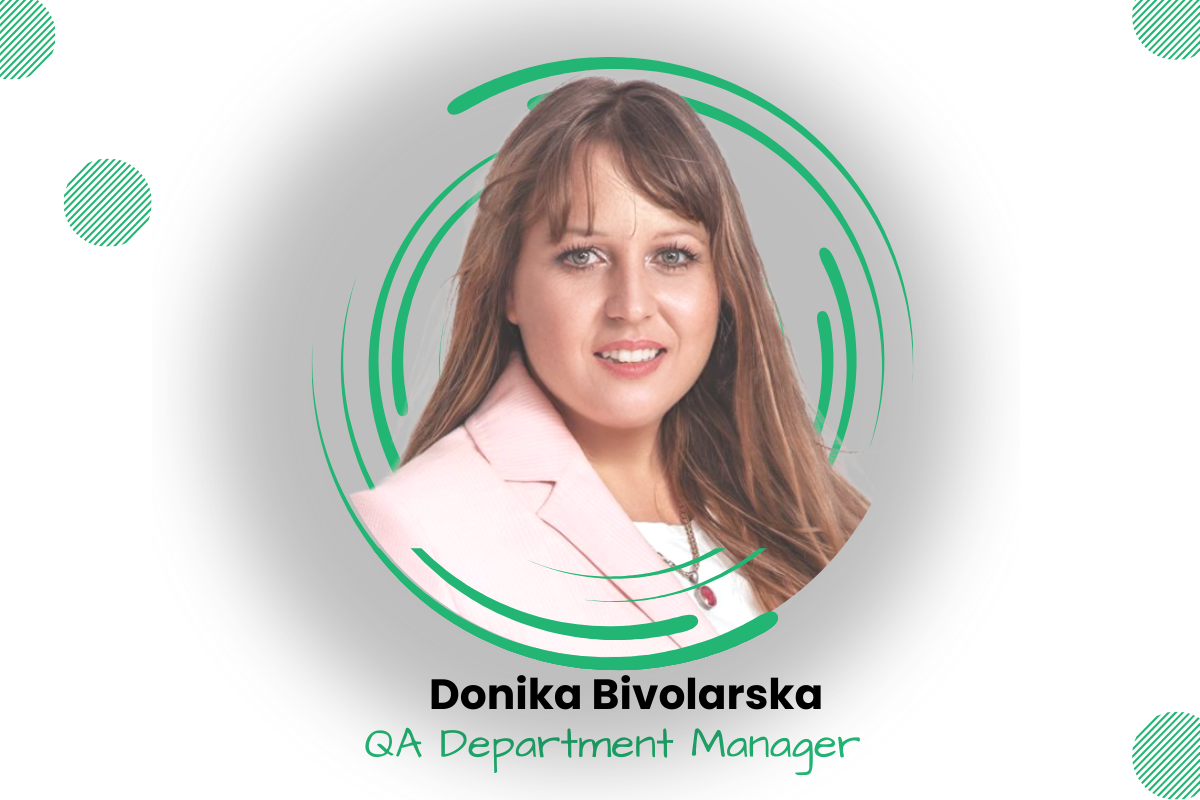
"I am looking for people who are motivated to grow and improve." shares Donika Bivolarska, QA Department Manager and Founder of QA Star Academy.
Tell us more about your career path.
I began my career in 2013 as a QA Specialist in a multinational IT company, where I had the opportunity to work on multiple projects for global leaders across their industries. My first impression was stepping into a high-tech world — everything felt almost like “space” to me.
At that time, QA was still relatively unknown in Bulgaria, and resources were scarce — which worked in my favor, as it gave me the chance to learn the profession from the books and build a solid foundation of knowledge.
Working on multiple projects simultaneously gave me the experience and perspective that naturally prepared me for leadership roles as a QA Lead and QA Manager. It also allowed me to observe both good and bad practices firsthand and see the outcomes of each. Mentoring other QA specialists became a turning point in my career — guiding them through their tasks, sharing knowledge, and seeing them succeed brought me immense satisfaction and joy.
My leadership journey was further strengthened through formal training in management and team-building, enhancing my ability to guide teams effectively.
Looking back, my career has been shaped by a combination of hands-on project experience, mentoring, and continuous learning.
In parallel with my corporate role, I am the founder of QA Star Academy — an industry-driven QA academy built around real business needs and international quality standards. With over 12 years of experience as a QA, QA Lead, and QA Manager, working on large-scale international projects for global leaders in their respective industries, I have had the opportunity to clearly see where the gap between solid QA education and real-world expectations exists.
I also personally interview candidates for QA positions, which gives me a unique perspective on the skills, knowledge, and mindset required to succeed in the real business environment. This insight directly informs the way I prepare future QA professionals, combining strong theoretical foundations with practical exercises designed to reflect real business scenarios.
As a candidate, have you had any strange interviews? What about interviews that impressed you?
I’ve been lucky enough not to experience any truly strange interviews.
The one that impressed me the most was actually the interview for the company I work for today. My CV was around eight pages long, detailing my entire QA experience and projects, and instead of skimming through it, the interviewers had clearly prepared thoughtful questions based on my background.
I immediately felt that my experience and knowledge were truly valued, and that level of personal attention and recognition made a lasting impression — it’s exactly why I chose to join this company.
What skills and qualities do you look for in a candidate? How can a candidate stand out during the interview?
For me, the most important qualities in a QA candidate go beyond technical skills.
Naturally, a solid understanding of QA processes, documentation, databases, web services, and strong theoretical foundations are essential - because what a QA specialist does every day is directly linked to their knowledge.
Equally important are soft skills: communication, motivation, and genuine passion for the profession.
QA is the role that connects all team members and acts as the gatekeeper of quality, so honesty, integrity, and alignment with the company’s values — passion, teamwork, and results-oriented thinking — matter a lot.
During the interview, what stands out to me most is authenticity. Candidates who give thoughtful, personal answers instead of repeating standard lines from the internet immediately catch my attention. And the questions they ask at the end of the interview often reveal their curiosity, eagerness to learn, and potential — sometimes more than anything else.
Ultimately, I look for people who are motivated to grow and improve, because with the right mindset, technical gaps can always be bridged.
What questions do you typically ask in technical interviews? Do you have specific tasks or problems that you often use to assess candidates?
I work with a clearly defined set of questions and evaluation criteria for each level — junior, mid, and senior — so candidates are assessed on equal terms and against the expectations of the role. At the same time, the interview always reflects the individual’s experience and background, as presented in their CV.
The questions are centered around good QA practices: understanding processes, databases, web services, testing on different environments, QA documentation, prioritization, estimation, and decision-making in realistic scenarios that are typical for the profession. For experienced candidates, I focus on how they approach testing in different contexts and environments, and whether they truly understand the reasoning behind their actions — not just the execution.
For candidates with little or no experience, I don’t expect practice — I expect solid theory. Concepts like QA processes, regression testing, client–server architecture, databases, and Agile ways of working are essential foundations, especially at the start of a career.
Ultimately, my interviews are structured but conversational. They are designed to reveal not only what candidates know, but how they think, how they reason, and how they would act in real situations — while ensuring fairness, clarity, and equal opportunity for everyone.
How important are good communication skills for a candidate? How do they impact the overall interview?
Communication skills are critical for any QA professional, because QA directly impacts not only the team dynamics, but also the quality of the product itself. From the very early stages — such as requirement analysis — a QA needs to be proactive: asking the right questions, clarifying expectations with business analysts or product owners, discussing implementation details with developers, and understanding risks and impact. All of this directly influences test planning, especially regression testing.
The same applies when timelines are tight or issues arise. A QA must be able to communicate risks early — whether testing time is being reduced, critical bugs appear late in the cycle, or quality concerns emerge. Clear and timely communication often makes the difference between a controlled release and a risky one.
During interviews, communication skills tell me a lot about a candidate. I pay close attention to how clearly they express their thoughts, whether they listen actively, and how they reason through a problem — even when they don’t know the answer.
I value candidates who think out loud, ask clarifying questions, and try to find solutions, rather than giving up or relying on scripted responses.
Ultimately, QA works with everyone — developers, managers, product owners, and sometimes clients. The ability to communicate clearly, confidently, and respectfully is not just a soft skill; it’s a core part of being a strong QA professional, and it significantly shapes both the interview experience and long-term success in the role.
How important is cultural fit when making a hiring decision? How do you assess whether a candidate will fit well into the team?
Cultural fit is extremely important to me — in fact, I would prioritize it over technical skills.
When a person is motivated, curious, and willing to learn, technical gaps can be closed over time. What cannot be taught easily are core values, mindset, and personal qualities shaped long before a professional career begins.
When someone doesn’t align with a company’s culture, it affects everyone — the team, the organization, and the individual themselves. They may struggle to collaborate, feel disconnected, or simply feel that they don’t belong. In the long run, that’s not a win for anyone.
I assess cultural fit mostly through behavior and interaction during the interview. I pay close attention to how candidates listen, communicate, respond to feedback, and handle situational questions related to conflict or teamwork. Traits like arrogance, lack of respect, or disengagement are clear red flags, while openness, integrity, and a collaborative mindset stand out immediately.
The values that matter most to me are integrity, teamwork above self, a customer-focused approach, and being results-oriented. When these are present, skills can be developed — but without them, even the strongest technical profile is rarely a good long-term fit.
What are the most common mistakes candidates make during an interview? What advice would you give candidates on how to prepare for an interview?
A common mistake candidates make is coming to interviews unprepared and relying entirely on past experience or knowledge gained a long time ago, without revisiting core QA fundamentals. This often becomes visible through gaps in basic concepts such as QA processes, databases, web services, or essential testing principles.
Other common mistakes include difficulty clearly explaining previous responsibilities and decisions, as well as a generally passive attitude during the interview. Candidates also tend to underestimate the importance of communication and engagement — especially when they don’t ask questions or show genuine interest in the company and its work. An interview is a two-way conversation.
What advice would you give to candidates who want to improve their technical skills? Are there any resources you would recommend?
My advice to candidates is to prepare thoughtfully: revisit core QA fundamentals, reflect on real scenarios from your experience, and be honest about what you know and what you are still learning.
This is a principle I strongly believe in and actively apply when working with aspiring QA professionals at QA Star Academy — focusing not only on building solid foundations, but also on mindset, preparation, and interview readiness. Technical gaps can be addressed over time, but motivation, attitude, and genuine curiosity are what leave a lasting impression.
Share more about the best (or worst) interviews you've conducted.
One of the most memorable interviews I’ve conducted recently was with a candidate who truly stood out.
They came well-prepared and genuinely motivated to grow in the QA profession. During the interview, they listened attentively, thoughtfully reasoned through each question, and asked clarifying questions when something wasn’t clear. By seeing how they approached and analyzed problems, I could immediately recognize their way of thinking — which is just as important in QA as technical knowledge. They answered each question clearly before adding extra insights, showing both confidence and reflection. Their professionalism and passion for QA made the interview truly inspiring.
What would you like candidates to know about the interview process in your company? What could be helpful for them in their preparation?
What I want candidates to know is that an interview in our company is a professional, respectful conversation — not a test to “catch” anyone. My goal as an interviewer is to understand each person’s experience, mindset, and potential, while giving them the space to share openly.
The process usually starts with the candidate telling their story — their background, experience, and how they approach QA work. From there, we discuss practical scenarios and explore technical skills, always in a supportive and constructive atmosphere. It’s an opportunity to show not just what you know, but how you think, how you reason, and how you approach problems.
For candidates, the most helpful preparation is to revisit core QA fundamentals, reflect on your past experiences, and be ready to discuss them thoughtfully. Listen carefully, ask questions when something isn’t clear, and engage in the conversation. An interview is a two-way process — it’s as much about seeing if the team and the role are the right fit for you as it is about showing your skills.
Share a funny story from your experience as an interviewer 😊
Funny moments in interviews often come from the little surprises that remind me how diverse and creative people can be.
For example, sometimes a candidate brings an unexpected perspective or analogy to explain a technical concept, and it makes everyone in the room smile — not because it’s “wrong,” but because it’s fresh and human. Those moments are a great reminder that interviews are not just about skills and experience, but also about curiosity, personality, and the joy of problem-solving together.